
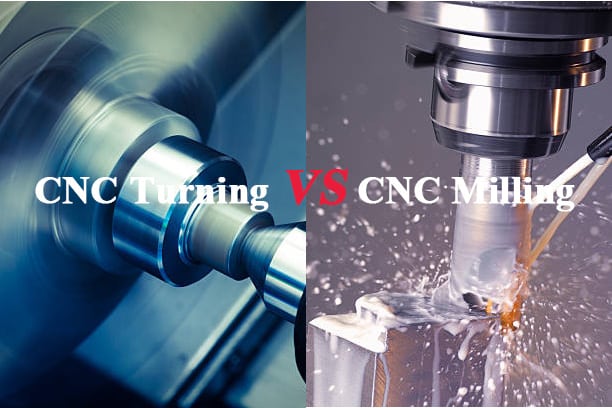

In precision manufacturing, understanding differences between CNC lathes and milling machines is critical. Although both are fundamental to CNC machining, they differ fundamentally in their operation, tooling, and applications, leading to unique geometric capabilities. Selecting the appropriate process is paramount, as it directly influences a design’s feasibility, production efficiency, cost, and the final component’s quality.

What is a CNC Lathe?
A CNC lathe is engineered for manufacturing cylindrical, conical, or axially symmetrical parts. In this process, the rotating workpiece is shaped by a stationary cutting tool that performs operations like turning, facing, threading, and boring with exceptional precision.
Key Characteristics:
- Motion: Rotating workpiece, fixed cutting tool.
- Common Materials: Machines steel, aluminum, titanium, and brass efficiently.
- Typical Parts: Ideal for shafts, bushings, screws, and cylindrical housings.
- Precision: Achieves tight tolerances, down to ±0.005 mm on advanced models.
CNC lathes excel in the high-speed production of precise rotational components, ensuring superior efficiency and consistency.
什么是 CNC 铣削?
In contrast to lathes, CNC milling secures the workpiece in place while a multi-axis rotating cutting tool machines it. This process is ideal for producing complex features like slots, cavities, and contoured surfaces.
Key Characteristics of CNC Milling:
- Tool Motion: A rotating spindle moves along 3, 4, or 5 axes.
- 材料兼容性: Machines a wide array of materials, from hardened metals to plastics and composites.
- Common Applications: Engine blocks, complex molds, aerospace brackets, and precision medical implants.
- Precision: Achieves tolerances as tight as ±0.005 mm on advanced centers.
CNC milling offers unmatched versatility for manufacturing prismatic, non-rotational parts with intricate geometries.
Core Difference Between CNC Lathe and CNC Milling
The core distinction between CNC turning and milling is their fundamental motion:
- CNC Lathe (Turning): 这 workpiece rotates against a stationary cutting tool.
- 数控铣削: 一个 rotating cutting tool moves against a fixed workpiece.
This primary difference dictates their capabilities, leading to key operational contrasts:
| Aspect | CNC Lathe (Turning) | CNC铣削 |
|---|---|---|
| Ideal Part Geometry | Rotational, radially symmetric parts (cylinders, cones) | Prismatic, flat, or complex 3D parts |
| Production Speed | Extremely fast for high-volume round parts | Slower per part, but offers unparalleled flexibility |
| Feature Complexity | Features along a single axis (e.g., tapers, threads) | Complex features (pockets, slots, 3D contours) |
| Cost Efficiency | Lower cost per part for high-volume rotational runs | Better for low/medium volumes of complex parts |
Choose a CNC lathe for high-speed production of round parts. Choose CNC milling for complex, multifaceted components requiring intricate detail.
CNC Lathe vs CNC Milling: Which Should You Choose?
The optimal machining process is determined by the part’s design and key business objectives like cost and timeline:
- 数控车床 are ideal for high-volume production of rotationally symmetric components (e.g., shafts, bushings), offering superior speed and repeatability.
- CNC铣削 is selected for complex, prismatic parts (e.g., brackets, housings) that require multi-axis flexibility for intricate contours and pockets.

In practice, a hybrid manufacturing strategy is frequently employed. A single part might be primarily turned on a lathe before transferring to a milling center for precision drilling or slotting. This integrated approach guarantees that all design specifications are met with the highest efficiency.
结论
A nuanced understanding of the distinctions between CNC车削 and milling is paramount for strategic decision-making in manufacturing. This knowledge directly informs effective sourcing, guides Design for Manufacturability (DFM) principles, and is indispensable for achieving significant cost optimization. CNC lathes deliver unmatched efficiency and speed for producing rotational, axisymmetric components, whereas CNC铣削 offers unparalleled versatility for complex, prismatic parts with intricate features. For B2B buyers, engineers, and procurement specialists, the critical task is to strategically align each process with the component’s core geometry, functional requirements, and target production volume to ensure optimal performance, quality, and value.
- How to Optimize Medical Part Geometry for 5-Axis CNC
- Why EV and Energy Storage Parts Need In-House CNC from Aluminum Die Casting Manufacturers
- Dimensional Stability After Passivation/Electropolishing
- Coating Adhesion Failure on Medical CNC Substrates
- DFM Rules for CNC Machined Medical Optical Assemblies: Avoid Costly Alignment Failures